A Currency of Kinglets
A Currency of Kinglets
Heads up: this section talks about death, particularly animals killed for scientific purposes. If that’s not great for your headspace today, skip to the next section, after the picture of books.
Generally we talk about living vicariously through books, but for the last few weeks I’ve been questioning if we can’t experience dying vicariously as well. Maybe that’s obvious on the surface—we experience living vicariously so why wouldn’t we experience dying vicariously too? But I’m not sure it’s obvious, or at least it wasn’t to me. In the past, I think I returned fully to myself once the dying started. I would mourn the character or subject (on one occasion, so intensely that I felt like I was mourning an actual human being for days), but I always felt separate from the experience of dying.
Maybe it’s the middle-aged birthday I had recently or a few of the K-dramas I watched that gave me this new sensation, but honestly, I blame the Greenland sharks. One January night I was washing the dishes under the gunk-revealing glow of the overhead LED light and the next segment of Science Friday came on—“What Greenland Sharks Are Teaching Us About Aging Eyes.” That piqued my interest, what with my aging eyes, thickening eyeglass lenses, and general fear of going blind and not being able to easily draw, write, or watch K-dramas (my high school friends once posed a hypothetical: “If you had to, would you rather go blind or deaf” and they chose blindness because, as I recall, the idea of giving up music was unbearable to them—I love all kinds of audio inputs, but I thought that was bananas). According to Wikipedia, Greenland sharks “are among the largest extant shark species, reaching a maximum confirmed length of 6.4 m (21 ft) and weighing more than 1,000 kg (2,200 lb). They reach sexual maturity around 150 years of age and their pups are born alive after an estimated gestation period of 8 to 18 years.[5]” That 150 years is not a typo. Greenland sharks may live as long as 400 years and yet, unlike us, maintain their eyesight. But to learn the secrets of the sharks’ eyes requires… well… the sharks’ eyes. Which means that incredible lifespan is cut short, maybe by centuries. There are times when you find yourself just… stopping. I stopped washing the dishes. I stopped listening to the rest of the episode. I stopped thinking about anything else except the many years of a shark’s life evaporating out of time.*
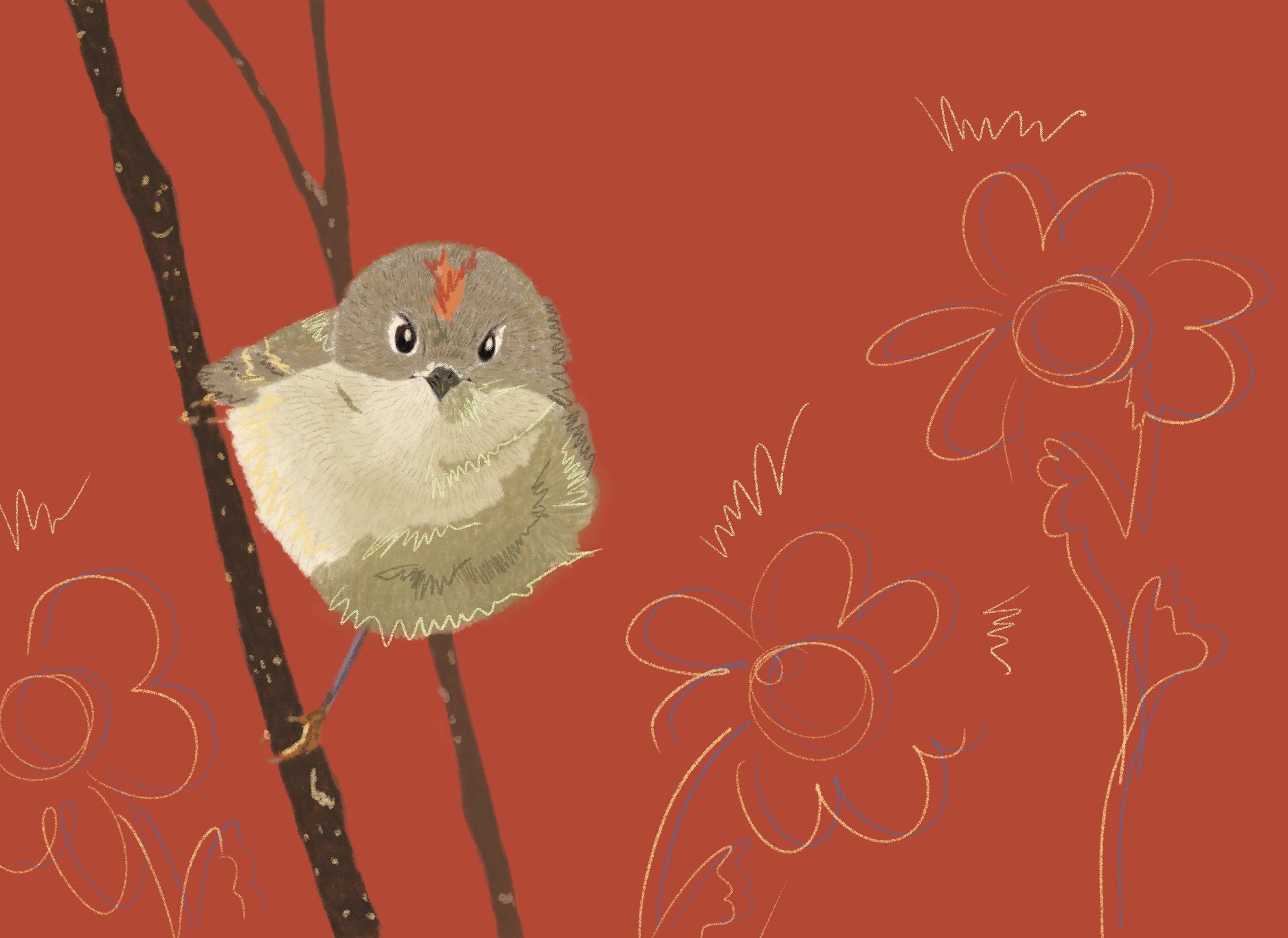
In Winter World, Bernd Heinrich wants to know how golden-crowned kinglets, tiny birds with with regal head feathers, survive the winters of the Northeastern United States. He kills several as he goes about answering that question. Heinrich writes, “Those who are familiar with ancient folklore, or are up above the rest of us a moral notch or two, kill ‘respectfully’ by offering prayers or apologies, in the hope that animals will ‘offer themselves’ up to be voluntarily killed. However, it is a sad fact that no animal cares if those who might eat them invent reasons to justify their acts (to make themselves feel good). But if any animals did offer themselves up for the greater good, then none as small as a kinglet would ever consider the value of its meager body to man as sufficient recompense for its own life. So, yes, I killed several kinglets (after getting the appropriate state and federal permits), really only because of curiosity and a hunger for knowledge. And with regrets but no prayers.” (123)
Heinrich describes the kinglet as “as close to an annual bird (in analogy with annual plants that regenerate each year only by seeds) as any bird gets.” (307) Most of the kinglets, he asserts, die every year in the wild though they can live much longer in captivity. The birds have higher than average batches of eggs, which helps maintain their population.
So here we have a 20 ft. shark that can live to 400 years old and an itty bitty 5g bird that lives on average a single year, and the thought of either’s demise fills me with some kind of existential dread that I don’t know how to name. Like we’re collectively dying. Like we’re losing something intangible but elemental.
The funny part is, I’m not afraid of my own death so much as what me dying means to other people (I’m pretty sure Lucas and Annie would croak without me taking care of them) and I’m far more afraid of the people I care about dying than the consequences of my own death. But lately the unfairness has weighed heavier and heavier under the onslaught of people in power being so cavalier with others’ lives.
I think those prayers and apologies Heinrich mentions are, in part, about acknowledging the consequences of our actions, with the inherent recognition that what we are doing is in self-interest, and by acknowledging those consequences and that self-interest, we are better able to discern what we need versus what we want. When I told Lucas about Winter World and questioned if some of my discomfort came from changing attitudes and technology over time (this book was first published in 2003), he mentioned the shift from “man has dominion over nature” to “humanity is part of nature.” That might be the case here, which brings up a discussion with another friend: “What way am I thinking now that I will view very differently later?”
I wonder about that question on a regular basis, which can be paralyzing when it comes to writing this newsletter every month. Even in the in-person conversations I’ve just had about this book I’ve wondered if I’ve said something unfair. Ultimately we have to forgive ourselves for the times when we get it wrong, acknowledge those mistakes, and move on with our improved knowledge. Life, if we’re doing right, is just kinda painful that way. But it also offers the reward of a better understanding of ourselves and the world around us.
I didn’t have the best time with Winter World. I questioned the rigor of the science in the kinglet study, which may have been plenty rigorous, but as presented didn’t imbue me with trust. I needed more detail and structure. Trusting the author, or at least feeling like you understand the author’s mindset, is very important in books like these, and I never quite got there. But I can say this book made me think quite a bit, so even though it was a struggle to get through it had value for me.
When you read or watch a story, do you feel like you grieve a character’s death as an observer, or are you vicariously experiencing their death? What were your takeaways from Winter World?
*Worth noting is that in the Greenland shark’s case, scientific study could help us understand how to conserve them, and they might be gathered directly or as fishing by-catch. You can learn more about them in “Blind, Slow, and 500 years old — or are they? How scientists are unravelling the secrets of Greenland sharks” from The Guardian, which does call into question if the sharks can live for centuries because of the difficulty of carbon dating for that refined a time scale.
Related Recommendations
I’m generally a “happy stuff as much as possible thanks” kind of person when it comes to the stories I read and watch, but of course there is much to appreciate and learn from in the stories that bring death to the forefront. Here are a few that have stuck with me the most:
Mr. Plankton, a K-drama available on Netflix, follows a terminally ill man with his ex-girlfriend in tow as he looks for his biological father (you’ll laugh and cry, that extra-painful combination that makes everything more tragic)
The book Our Happy Time by Gong Ji-Young is the story of a man on death row and a woman who has tried to commit suicide multiple times
Dying for Sex is available on Hulu and is inspired by Molly Kochan’s experience with terminal cancer (Michelle Williams and Jenny Slate are wonderful as best friends Molly and Nikki)
How High We Go in the Dark is a collection of connected SciFi short stories that I have yet to finish, but think about on a regular basis
Let’s Imagine
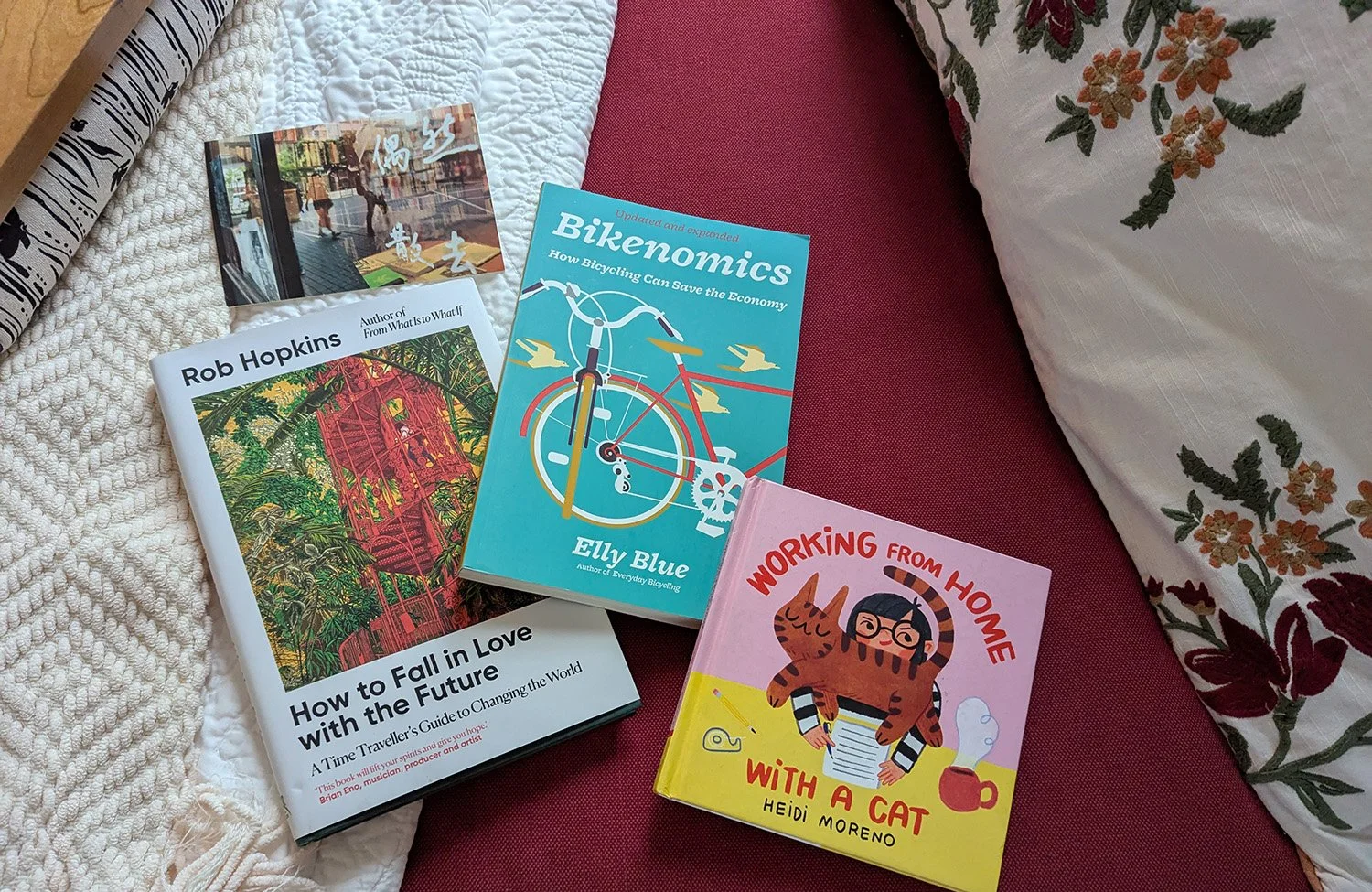
Raise your hand if you need a little sunshine in your life after that last section, or just generally. Me too, and I found it at the used bookstore (thanks, The Book Deal). My bookstore treasure hunt resulted in a postcard of a bookstore in Hong Kong, How to Fall in Love with the Future: A Time Traveller’s Guide to Changing the World by Rob Hopkins, Bikenomics: How Bicycling Can Save the Economy by Elly Blue, and Working from Home with a Cat by Heidi Moreno.
Heidi Moreno’s illustrations are a delight. You can see more on her website for yourself: heidiroo.com. The frog postcard was a personal favorite.
I have yet to dig into Bikenomics, but How to Fall in Love with the Future has kept buoyed me throughout the last few days. Hopkins not only challenges us to imagine a better future, but gives examples of people using their imaginations exactly this way—and then making those futures happen. His podcast series, “From What If to What Next,” invited guests to discuss topics like “What if sports could accelerate the shift to a low carbon culture?” (Episode 79), “What if energy generation was in community hands?” (Episode 57), and “What if we redesigned cities based on children’s needs?” (Episode 45)
I’m midway through the book and I appreciate that Hopkins is encouraging but not ignorant of the challenges. “Are we so overcome with dread, so paralysed by the scale of the challenge, that we can’t even imagine putting out the fire? If so, that’s ridiculous because history tells us, repeatedly, that even in the darkest hour, even when the odds look unwinnable, the tide can turn.” (24) It’s natural to feel paralyzed, especially now with so much happening every day, but we know there are people in power inflicting that paralysis on us on purpose. Yet our imaginations, when released from the weight of our despair, are stronger than their selfishness, and trained on dreams of a better future, our willpower can defeat their greed.
What beautiful thing can you imagine for your neighborhood, your city, or the world? (If you’re struggling with this one because the world has got you so down right now, I get it. Consider giving How to Fall in Love with the Future a try and check out the newsletter Fix the News.)
I am currently winding down my Facebook account for deletion. As much as I want to only focus on a better future in real space, it’s critical for us to imagine a better digital world. I’ve been on Facebook for 20 years (it launched when I was in college) and this comes with many weird feelings. I’ve barely been on it for years and done little besides like a few photos and post an article or two, but it still feels like I’m cutting ties with friends. I messaged the people that I’d like to actively keep in touch with (who I thought might also like to keep in touch with me, and if I had no other form of contact with them), but there were many more people that I hadn’t spoken to even when we became Facebook “friends.” And you know what I discovered winding down my account? So many people I thought were still there, a part of my “network,” just weren’t. It’s a hollow place. Worse, it’s a hollow place where lies are amplified for profit. I don’t want to be a part of that network on a small or large scale. Being on Facebook feels like accepting enshittification as the only path forward.
So, without it, what future does that leave me? Dreaming of a better social network with proper guardrails? I have trouble picturing social media as anything other than a slot machine we keep swiping through searching for endorphin wins. But without meaning to I did imagine a better life online, back when I stopped logging into Facebook and Instagram so often. I started some small writing discord groups, which meant meaningful interactions with others instead of thumbs-up-and-runs. I also took social media apps off my phone, so instead of going there when I wanted entertainment, I would read an ebook instead. Now when I want to see what society at large has to say, I tune into subreddits that are local (Madison, Minneapolis) or topic-specific (like native plants). I’ll find myself drifting into the toxic waters of the reddit homepage sometimes, but I can feel myself getting sick off of it pretty quickly, like I’m dehydrated and mainlining sugar.
In our twenties, Lucas and I used to give ourselves crap for talking about “things will be better when” because we didn’t feel like we were living in the present. However, we were actively working toward what we wanted, and these days I see that phrase as a guiding light. “Things will be better when…” followed, importantly, with “We’ll get there by…”
We’ve got this—the first step is imagining it.
March’s Book
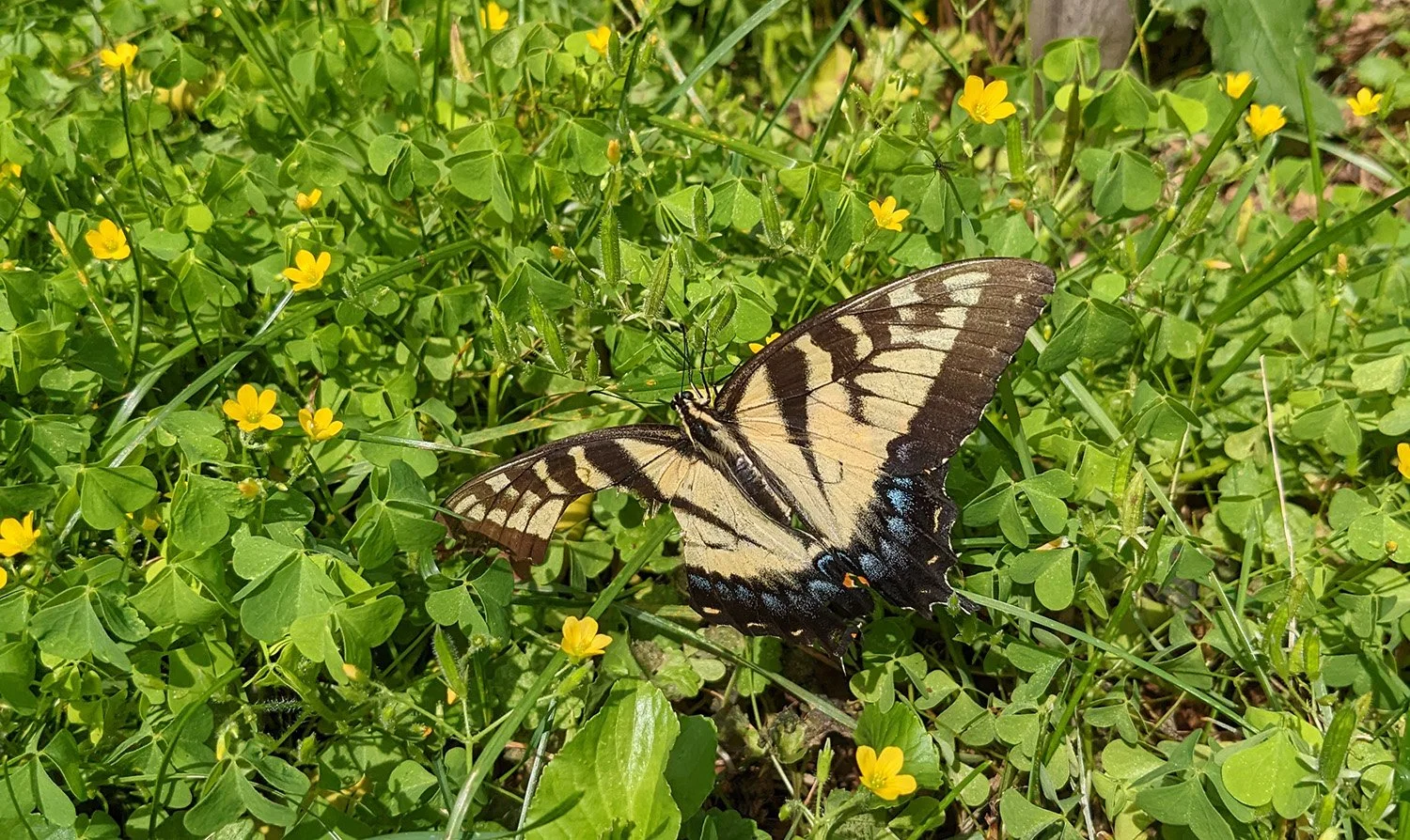
Flowers are tentatively poking up their heads and we’re moving on from Winter World to A Billion Butterflies: A Life in Climate and Chaos Theory. Apparently there are few butterflies in this book—this is a memoir from a climate scientist—so please calibrate your expectations accordingly. :)
Image Credits
Reference photo for Ruby-Crowned Kinglet by Nate Rathbun/USFWS
Photos by Leigh or Lucas Gray
Citations
Heinrich, Bernd. Winter World: The Ingenuity of Animal Survival. Ecco, an imprint of HarperCollins Publishers, 2003.
Greenland shark. (2026, February 27). In Wikipedia. https://en.wikipedia.org/wiki/Greenland_shark
Hopkins, Rob. How to Fall in Love with the Future: A Time Traveller’s Guide to Changing the World. Chelsea Green Publishing, 2025.