Shifting the World
restless
dormant means not active
just this minute.
but the dormant
can still be restless,
then suddenly,
eruptive.
enough to shift the world.
Ancient & Ongoing Eruptions
Volcanoes from Underwater to Outer Space
Volcanoes are so hot right now, if you’re a fan of Tom Hiddleston, that is. (I am.) Pompeii: Out of Time recently dropped on National Geographic, with Hiddleston leading us along the paths of three people trying to survive during the eruption of Vesuvius. It was a bit goofy at the start, but sincere and compelling. By the third episode, I was completely invested. It’s a look at everyday Pompeiian life, as well as human instincts in an emergency, during the phases of the eruption. I expected Hiddleston to be a distant narrator, but he visited Pompeii as a teenager and it stuck with him ever since.
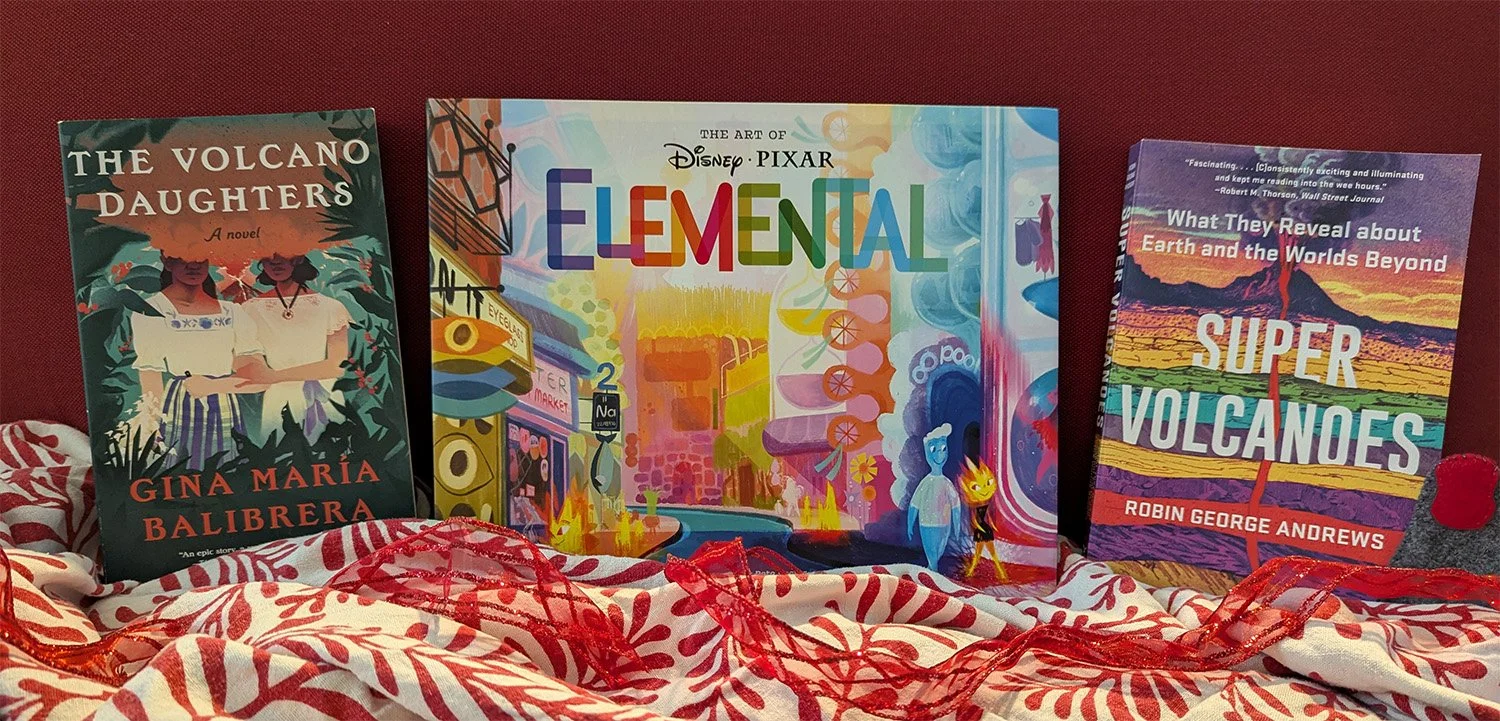
Living in the Midwest all my life, and despite having visited Volcano National Park in Hawai’i, volcanoes feel like something out of science fiction to me. I can understand why Hiddleston was invested in telling the human story of a volcanic eruption and Robin George Andrews, the author of Super Volcanoes, wanted to share their many incarnations. Right from the introduction, you can feel Andrews’s enthusiasm:
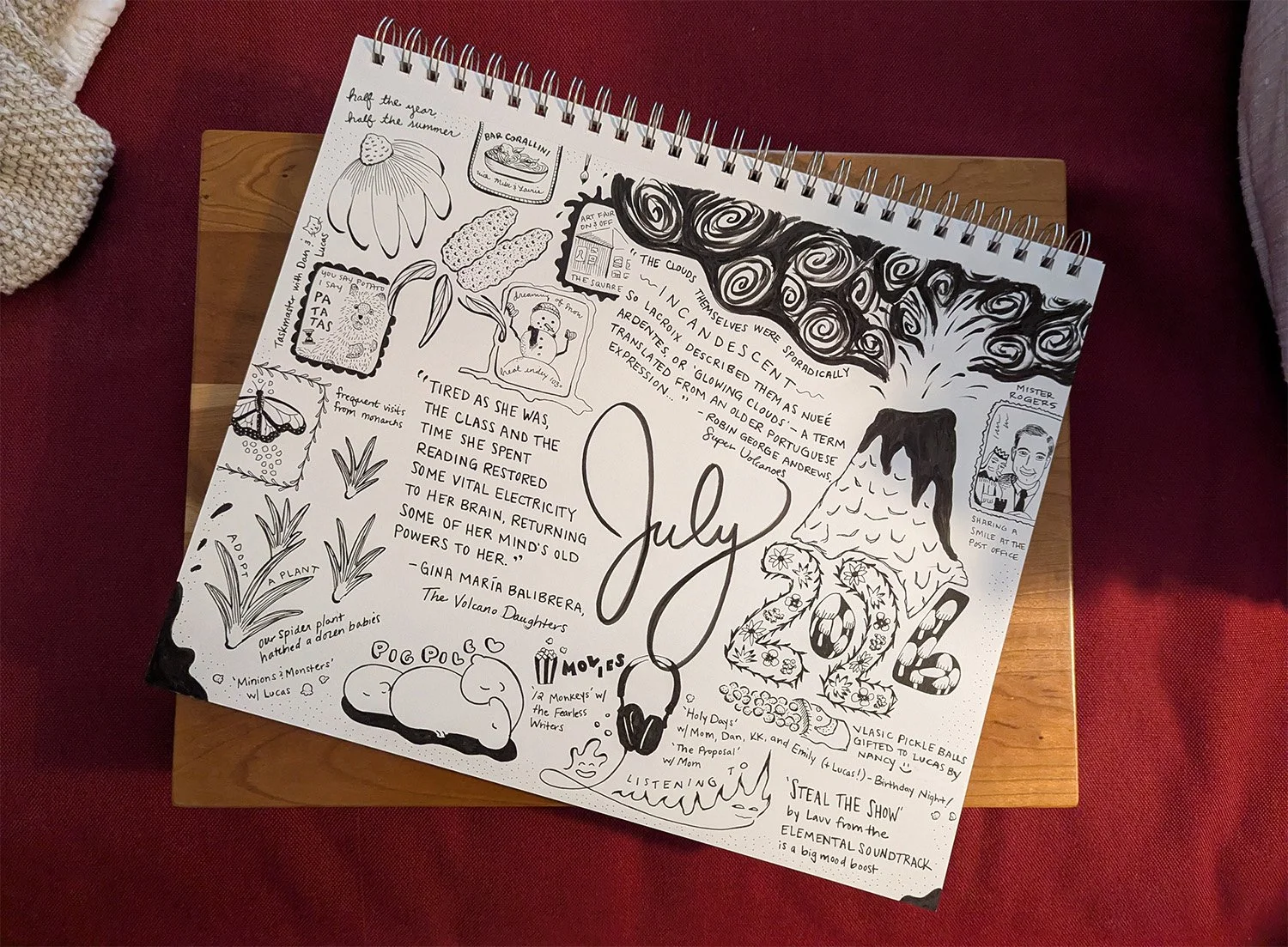
“Volcanoes all over the world make their own magic. Eruptions at the bottom of the oceans grow shimmering cities of glass. Lakes of molten rock pool at the top of the glaciated Mount Michael, a volcano hiding on an island just shy of Antarctica. … Orbiting our Sun are planets and moons that, simply by cooling down, can create eruptions that beggar belief: those where lava breaches the gravity well of the world and shoots off into space… those that, with time, build volcanoes so immense that they change the journey of these worlds around the Sun.” (XVII-XVIII)
—Robin George Andrews, Super Volcanoes
Andrews takes us on a tour of volcanoes across the continents, under the sea, and beyond our world. My favorites were the underwater volcanoes and the volcanoes on Mars, which are the largest in our solar system—phenomenally large. (NASA has a video to demonstrate how this is possible: Mars in a Minute: How Did Mars Get Such Enormous Mountains?)
However, I struggled with the very casual writing style, the unpolished quotations from scientists I couldn’t really distinguish from one another, and what I felt was ultimately an imbalance between enthusiasm and facts (there was a lot of room in this book for interesting details, filled instead with telling us how cool something was). We got a few low-res, black and white photos/illustrations at the beginning of chapters, but illustrations that demonstrated how the various volcanoes worked would have gone a long way. That said, I’m grateful to Andrews for bringing so many interesting volcanoes and space missions to my awareness.
Want a volcanoes refresher? Check out Britannica’s How Volcanoes Work, Explained by a Volcanologist. It’s a 5-minute video with some great shots of eruptions and flows. For more volcano action, check out the very first (!!) episode of my favorite podcast, Ologies: Volcanology (VOLCANOES) with Jess Phoenix.
What did you find the most interesting in Super Volcanoes? Book aside, is there a volcano or volcano movie/story you feel particularly drawn to?
Shared Laughter
What stood out the most to me about Volcano Daughters by Gina María Balibrera was another type of eruption—carcajada (laughter). The molten heart of Volcano Daughters is the relationships of women, not just the sisters Gabriela and Consuelo, but all the women in their lives. Balibrera, with her talent for unearthing emotion in her characters, writes throughout the book about the laughter that connects them. “Graciela didn’t understand a púchica thing that she had said, besides something about a baby named Roger or Thomasina, but she cackled too—joining a carcajada felt good.” (203)
A good laugh is an even greater treasure in times of hurt, and this book has a lot of hurt. For that reason, I might have let this book sit two-thirds finished for months. But thanks to choosing it for this newsletter and the recent readathon practice pushing me to finish more books, I can say the ending was worth it and felt right, and I would have done myself a disservice if I had waited too long for the conclusion.
There was a lot to appreciate in this book—what sank in the most with you from Volcano Daughters?
Fire & Water
If you haven’t seen the 2023 Disney Pixar movie Elemental yet, consider booking it for your next movie night! It’s the story of Ember, daughter of Fire immigrant parents, in their home of Element City. Her father would like her to take over his store one day soon, but she’s actually too hotheaded for the job. During a mishap in the store, Ember meets Wade, a city inspector. Though Wade is a softie, they’re immediately at odds—he has to write so many tickets that the store may have to close.
This movie became a favorite of mine after my second watch at home when I paired it with Good Chemistry: The Story of Elemental, the 40-minute documentary that digs into the inspiration and meaning of the movie with the director Peter Sohn. So naturally I took the excuse of our toasty July theme to purchase The Art of Elemental, which had long been on my wish list. There are no volcanoes that I noticed in the movie, so the association was a stretch, but Lucas can attest that I’m a bit of a weasel at justifying book purchases. It’s an endearing character flaw, right, Lucas? Kinda adorable, even? If I keep saying it enough, maybe I’ll make it true…
Once I discovered art books for my favorite animated movies, I couldn’t help myself. (Wait… Now I remember. This is Lucas’s fault because he gave me my first two.) Seeing the years of work, by many people, put into a 90-120 minute long movie, is incredible motivation for any creative work-in-progress. The best I’ve read is The Art of Zootopia, which talked about how much re-drafting was involved in creating and finalizing the story—it was the boost I needed during a rough writing patch. For me, that book was the perfect blend of concept art and “making of” background, and I’ve been chasing that ratio ever since.
The Art of Elemental has also earned a top spot in my art book collection, with gorgeous concept art and a very personal introduction written by Peter Sohn:
“But as I grew up, I began to see all these other families that immigrated to this country going through the same things my parents went through: different cultures mixing, and sometimes not mixing, with each other to make it work. I started to actually hear what was in my parents’ stories and to appreciate all the hard work it took for them to create a life here for my brother and me. That appreciation turned into a gratefulness that then turned into a deeper love, which then turned into a cry-when-I-think-about-it, soul-crushing weight of debt that can never be repaid.” (9)
You can find Elemental and Good Chemistry: The Story of Elemental on Disney Plus.
Have you read any art books? What was your favorite?
August on the Water
with an Arctic Breeze
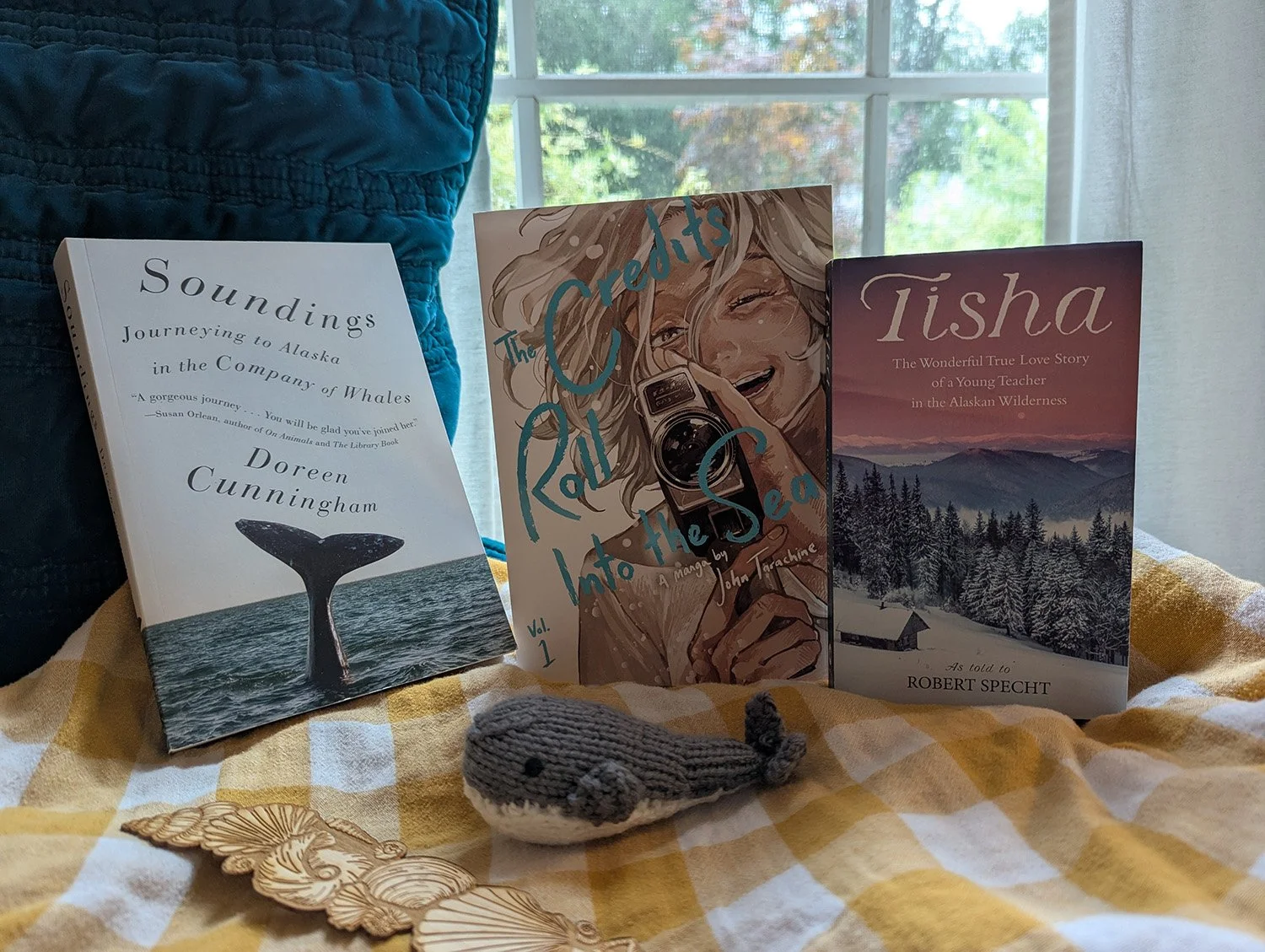
We need to cool off after a July spent volcano-side! There are three different books either on the water or in the Arctic to choose from this month if you’d like to read along.
Soundings: Journeying to Alaska in the Company of Whales
a memoir by Doreen Cunningham
With her toddler son, a journalist follows mother whales from Mexico to Alaska. On the front cover is the endorsement of Susan Orlean, author of The Library Book: “A gorgeous journey . . . You will be glad you’ve joined her.”
Tisha: The Wonderful True Love Story of a Young Teacher in the Alaskan Wilderness
as told to Robert Specht
I picked this book up at the gift shop at Glacier Bay National Park and Preserve when we visited Alaska in 2019. I then sank into the book like it was my favorite spot on the couch.
The Credits Roll Into the Sea, Vol. 1
a graphic novel by John Tarachine
This popular manga from Japan has just recently been published in English and is the story of a 65-year-old woman who decides to enroll in film school.
P.S. It was raining when I took the book photos for this month, which is why they’re so dark and why I shot in front of the window. It’s been so long since we had rain, I wanted to commemorate it.
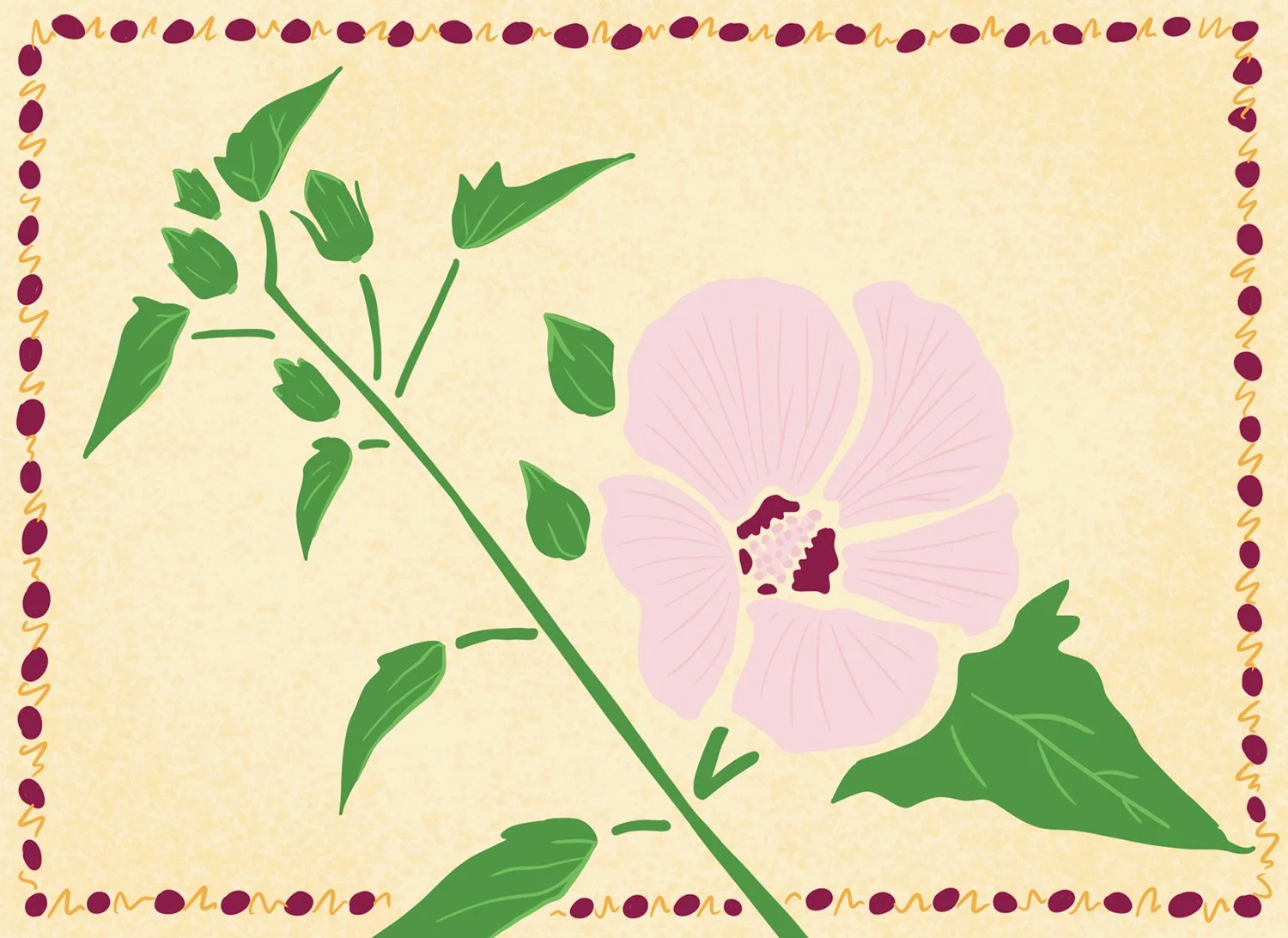
Our swamp mallow finally bloomed!
Five Hopeful Things
The Clean Up Edition
Lucas started playing a game last night where you fix a messy library, Librarian: Tidy Up the Arcane Library! He didn’t want to go to bed. He called it a puzzle, but put another way, he was hooked on a game where he cleaned a mess he wasn’t responsible for. I get the appeal. Knowing something, somewhere, is better, is sometimes all I need to get back to the mess that’s all mine or partially mine, i.e. humanity’s. So the list this month is mostly about cleaning up, reorganizing, and rethinking, plus one small interaction that made my day.
1. Reclaiming Climate Data
Climate.us is a website created by previous NOAA employees to replace the lost Climate.gov. Rebecca Lindsey, head of the project, told NPR, “Climate.gov was never about — and Climate.us will never be about — telling Americans what to do about climate change… The site will continue to be nonpartisan but will be focusing on the science and explaining science and showing people what the data show.” Read more on NPR: “Ex-NOAA employees re-create a valuable climate data site…”
2. Rethinking the Rest of Summer
I love this Summer Side Quest BINGO from Kathryn Kellogg’s Going Zero Waste. Summer is halfway over, and every day, I feel like I’m rushing to get ready for whatever the next thing on my to do list is. I’ve forgotten what I did yesterday and I can’t remember what I need to do tomorrow, I only exist in the list. But BINGO helped me remember some of the fun moments I’ve had this summer and gave me ideas for ways to take a break this weekend. I’m going to hang it on the fridge.
3. Reorganizing Our Plates
We know eating more plants is better for our health and for the environment, but it’s not always easy to figure out how. My favorite cookbook lately has been Plant You by Carleigh Bodrug. Her recipes are manageable, feature a lot of plants, and, importantly, are delicious! We made her Golden Immunity Stew this week and it was an instant favorite. While that recipe is only in her book, she shares quite a few others you can try at plantyou.com/recipes.
4. Cleaning Up Our Clothing Waste
This is a tidbit from Fix the News regarding clothing companies in the EU—“From 20 July, companies with more than 250 staff can no longer bin or incinerate unsold clothing, footwear and accessories, and must sell, discount or donate them instead.” Hopefully this will lead to long-term change in how clothing companies operate, leading to less overproduction and waste. Wouldn’t it be great if we could make it happen in the U.S. too? See the full newsletter here >>
5. Shared Smiles at the Post Office
While waiting in line at the post office, I decided on the sheet of stamps celebrating 250 years of delivering the mail. When I arrived at the counter, I noticed that there was also a display for Mister Rogers stamps, so I had to ask for a sheet of those too. With that, our interaction went from all business to a small moment of unspoken bonding—I wish I could have captured the mail clerk’s smile. It made me smile too.
One last related note and then I’ll sign off for the month. Last weekend I bought a sticker from Makers Market Square in Mt. Horeb. It read: “Be the person Mr. Rogers knew you could be.”

Credits
All doodles and photos by Leigh Anne Gray.
The quotations for the book reviews are from the following: the 2022 paperback edition of Super Volcanoes: What They Reveal about Earth and the Worlds Beyond by Robin George Andrews, published by W. W. Norton & Company; the 2025 paperback edition of Volcano Daughters by Gina María Balibrera, published by Vintage Books, a division of Penguin Random House LLC; and the 2023 hardcover edition of The Art of Elemental, published by Chronicle Books LLC, copyright Disney Enterprises Inc. and Pixar Animation Studios.