Life, Collected
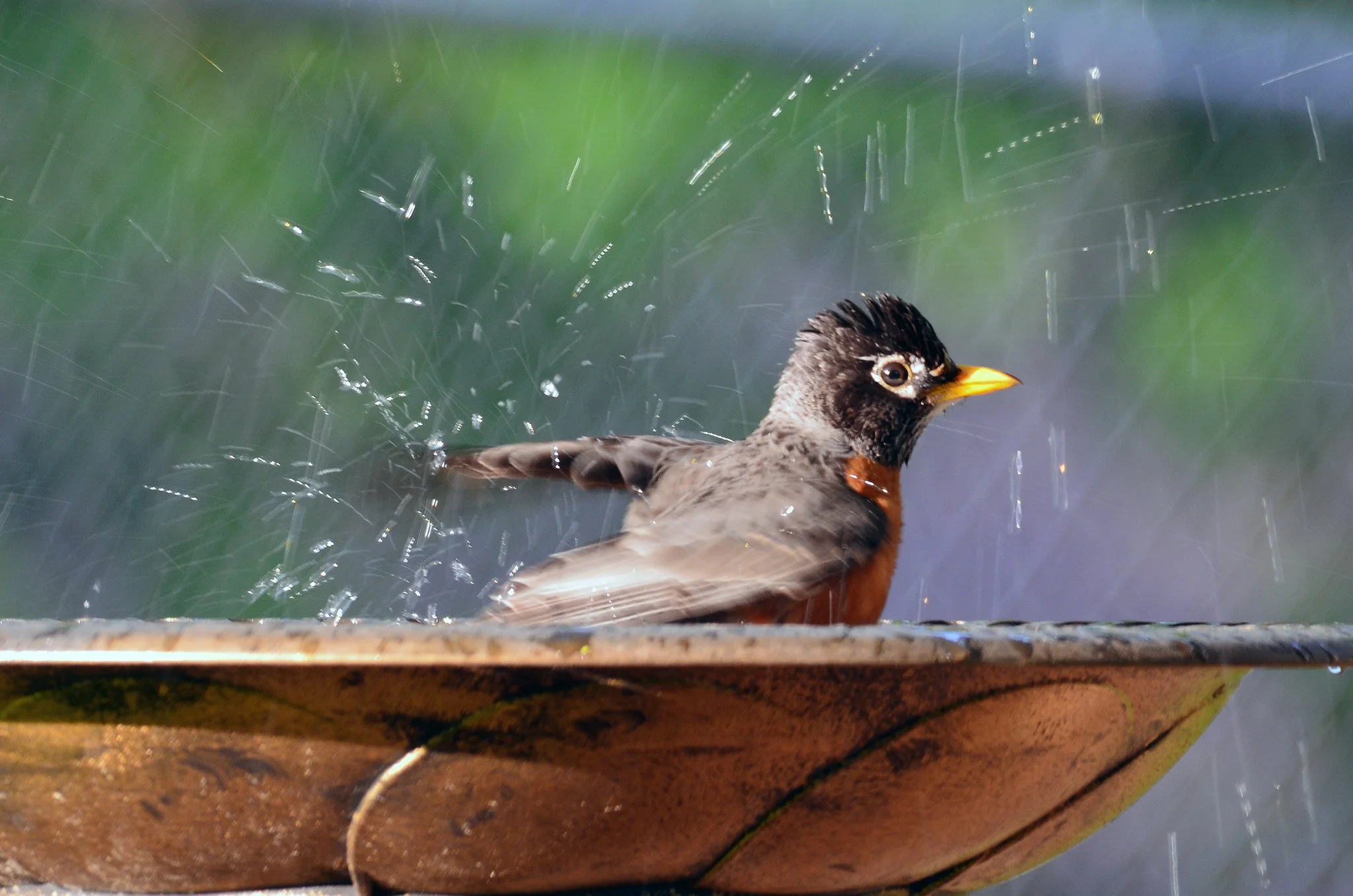
“American Robin” by Courtney Celley/USFWS
See You Saturday
(a poem for March 28)
There is a desert between the last winter snow
and the first spring rain. Brittle leaves tumble
over dry dirt and pavement, catching in fences
like the robin confused by our garden chicken wire,
unable to reach his friend. All that was required
was to go any other direction. I startled him
with a strawberry top and he flew and flew,
released from his self-imprisonment.
I’ve been waiting for the rain. The day has been gray,
relentless gray. Solid, flat, heavy, like they paved the sky.
There are no regulations for that. They wouldn’t care regardless.
“It’s good for the economy,” they’d say. “You need this
SUPER SKY LOT WITH MAX LOAD HYPERDRIVE COMPATIBLE STALLS.”
Maybe, someday, we’d say, “Is anyone actually up there?”
But we might not worry until we noticed the 5,342nd crack.
A few casualties from falling concrete would get us talking:
“Negligence!” “Chicken Little Conspiracy!” “Really, the odds are small for you personally…”
There are always losses for the sake of progress. Move fast, break things.
Like people. And the planet.
Shrug emoji.
With a walk to the mailbox a few blocks away,
Lucas and I summon the rain. We have no umbrella, no rain jackets.
Even so, I don’t feel the first drops. They speckle the sidewalk
like spots on a robin’s egg. The salutation smears
on the postcard I carry. Harder and faster,
the clouds deliver. A hush and then a roar.
There is a raindrop for every bit of pavement.
We could be the rain.
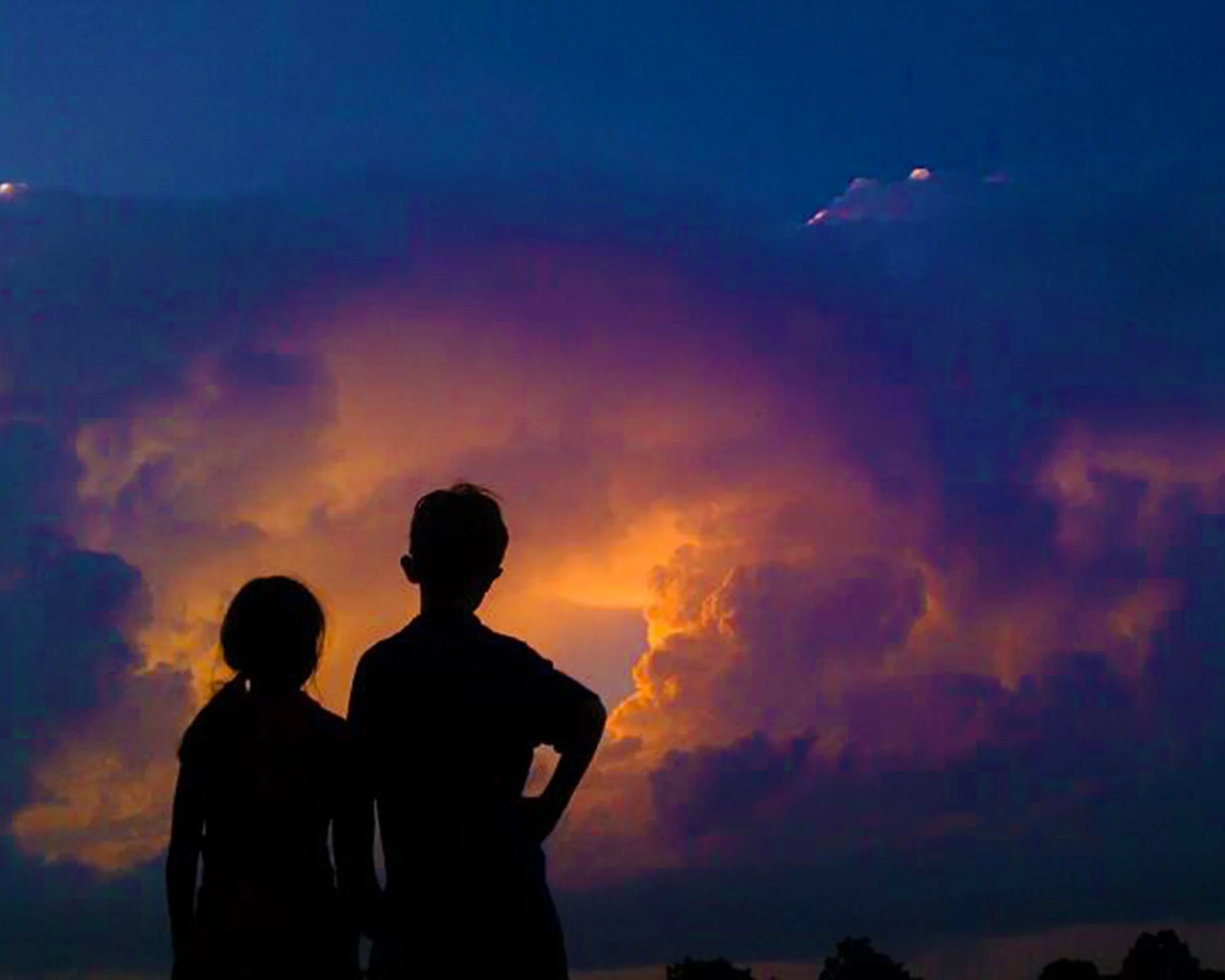
“Summer storm clouds form over Columbia, MO” by Ashley Spratt/USFWS
Collecting the Everyday
I wrote this poem last night with my favorite journal (rose pink, 8x10, lay-flat binding; I kid you not, I bought a dozen—I’m old enough to know when you love something you have to stock up before it’s ruined or discontinued). I sat in the sunroom in the near-dark and listened to the rain. For two hours, my phone was far away and I focused on only this. Writing on paper with my favorite pen (Pilot G-2 0.7mm, you can get refills!) means squiggling out the words that aren’t right, jotting fresh words above or off to the side, and rewriting the poem until I feel it works. I did that four times.
The robin befuddled by the fence, personally waiting for the rain to come, and a mailbox walk that resulted in a cold shower were all things that happened yesterday. (Lucas deserves credit for saying we had “summoned the rain.”) I collected these bits half-consciously, knowing I wanted to write a poem for this newsletter, but I wish I had done it just because. When Lucas read it, he said it made him think about the mundane events of his day a different way. Honestly, I made myself think about the mundane events of my day a different way.
I had a decently dedicated journaling practice for a while there, but it dropped off the last six months. Things were extra stressful and I didn’t want to immortalize being a crabapple about everything, but I let loose last weekend because I was so very frustrated about a personal thing and I needed to get it out. Then I thought, “Surely I can say something nice as well?” And I did, because there were lovely parts of that weekend in addition to the crappy ones. If I hadn’t done that, I don’t know that I would have written a poem this week—that frustrating thing would have eaten me up instead.
We all need mental space to process and appreciate our lives, and to determine who we are and how we want to live. We get less and less of that these days by societal default, but we can take it back. Cal Newport, the author of Deep Work, shared a guest essay today in The New York Times: “There’s a Good Reason Why You Can’t Concentrate,” calling for a “full revolution in defense of thinking.” (The link is a gift article.) I don’t want to say too much about it because I think it’s best to read it from start to finish. Please considering giving it a read (or a listen, as it is also available as audio).
Try It Yourself
I know, most of us rarely have hours to sit with a notebook. But we can still collect our thoughts. This weekend, take a few minutes and write a sentence or two about a smidgeon of your average day. Are you almost out of peanut butter? How long have you had that tchotchke on the mantle? Why is there a groove on the floor over there?
Then write a little more about that mundane thing or maybe a different thing (do they connect?). You might have amused yourself, or felt a big emotion—anger, sadness, joy—and want to share it. Just wait. Don’t share it for at least two hours. Give yourself space and your thoughts some fresh air. Then, if you want to share, talk to someone about it face to face or write it on the back of a postcard and send it as snail mail. (If you send it to me, I’ll write back!)
Heartened by A Billion Butterflies
At this point you might be saying, “Dude, did you even read the book? Are you just stalling?” I did! I swear! And it was so good! A Billion Butterflies: A Life in Climate and Chaos Theory by Dr. Jagadish Shukla is a new favorite. Dr. Shukla is currently 82 years old, and it’s incredible to hear his story from the beginning, both in terms of meteorology (he’s seen/been a part of so many advancements in science) and geography (he grew up in a village in India). His thoughtful, friendly writing style is a pleasure for the non-meteorologists among us, making the science of weather and climate comprehensible right from the two-page prologue, “Climate 101.”
But more than anything, Dr. Shukla’s attitude stands out. His interest in the weather stemmed from the monsoons critical to his village’s survival. When he saw something that needed doing, he went for it, regardless of how easy it was or if it was deemed possible by anyone else, and stuck through it and maintained his hope for a better future, including when he became the target of an investigation after upsetting oil and gas companies and their political/media profit circle:
“It took me a while to realize it, but at some point during the eighteen-month investigation, those memories began revealing something else: It wasn’t actually the science that had been my life raft. When I was a young man looking out the window of that hurricane hunter [airplane], it wasn’t making a perfect model that drove me; it was making a more perfect world. Hope, optimism, and an obligation to help others; it was that commitment—not the science itself—that had been my terra firma all along.” (235)
—Dr. Jagadish Shukla, A Billion Butterflies
This book gently sweeps away the sense of helplessness and self-protective ignorance that threatens our future and humanity—it is quietly heartening. We’ve made great strides throughout human civilization. We can make even greater ones in the future if we care for each other.
What did you take away from A Billion Butterflies? What do you consider your terra firma? Do you have a favorite memoir?
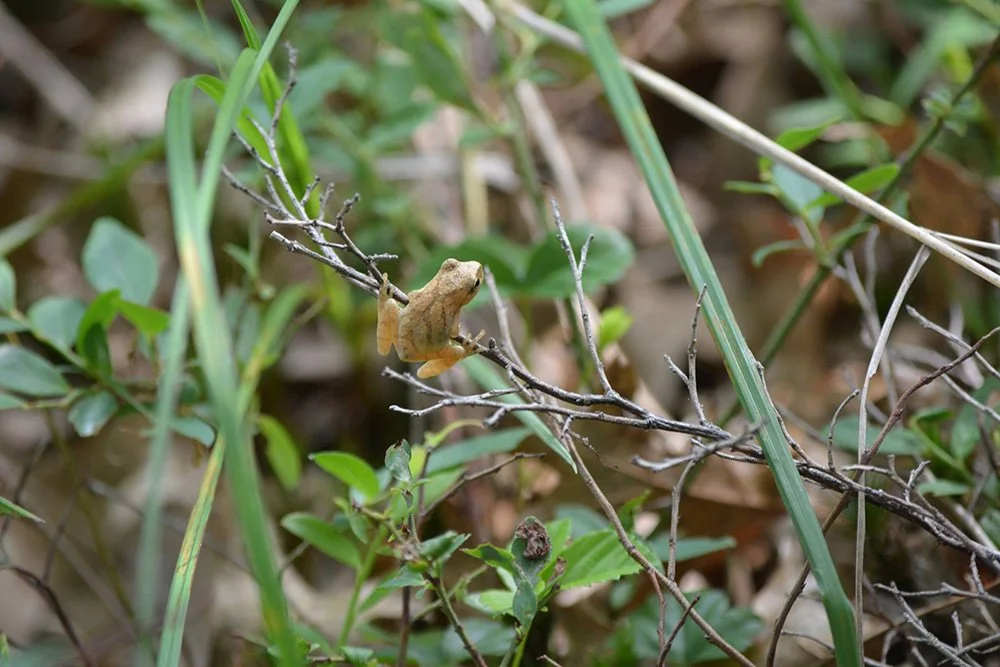
“Spring Peeper” by Ariel Lepito/USFWS
April’s Book
Prairie Potholes and P.S. Peepers
Sea of Grass: The Conquest, Ruin, and Redemption of Nature on the American Prairie by Dave Hage and Josephine Marcotty is our next book. I first spotted it at Leopold’s, at eye level on the new releases shelf. Leopold’s has a small footprint and splits its space between a huddle of bookcases and a pack of tables parallel to the bar. This encourages browsing while waiting for a seat (a frequent experience), but discourages planting yourself in front of any particular section. Like Pac-Man pursued by the Ghost Gang, it’s best if you take a nibble of a book or two before scooting along. But it was difficult for me to close the cover of Sea of Grass, with Hage and Marcotty offering us these sentences on the first few pages:
“The silence is stunning until you really listen: The wind sighs over the grass and a bobolink hurls its song into the air.” (xiii)
“Farther east, in the mixed-grass prairie of the Dakotas, eastern Nebraska, and western Minnesota, tiny lakes known as prairie potholes lie scattered like sequins across the land, providing nesting grounds for fully half of North America’s birds. A recent soil analysis found that one cubic yard of tallgrass prairie sod contains so many grasses, sedges, flowers, burrowing mammals, worms, mites, nematodes, and soil microbes that on a small scale it rivals the tropical rainforest for biological diversity.” (xiv)
Prairie potholes and rainforest rivalry? Yeah, that was coming home with me.
P.S. The photo above is a frog known as the spring peeper. I had to look up why. According to Wikipedia, “…the spring peeper has a high-pitched call similar to that of a young chicken, only much louder and rising slightly in tone. They are among the first frogs in the regions to call in the spring.”
P.P.S. One of my favorite things I’ve watched recently is the travel film “KYOTO in the Rain” by Mei Time. At fifteen minutes, it makes for a restorative, quiet break. If you have more time, I also recommend “Winter in Aomori.”
Image Credits
No time for a doodle this month! All images in this edition of the newsletter are by UWFWS Midwest and in the public domain.
Citations
Newport, Cal. (2026, March 27) There’s a Good Reason Why You Can’t Concentrate. The New York Times.
Shukla, Dr. Jagadish. A Billion Butterflies: A Life in Climate and Chaos Theory. St. Martin’s Press, 2025.
Hage, Dave & Marcotty, Josephine. Sea of Grass: The Conquest, Ruin, and Redemption of Nature on the American Prairie. Random House, 2025.
Spring Peeper. (2026, March 27). In Wikipedia. https://en.wikipedia.org/wiki/Spring_peeper