To Spot or to Gaze?
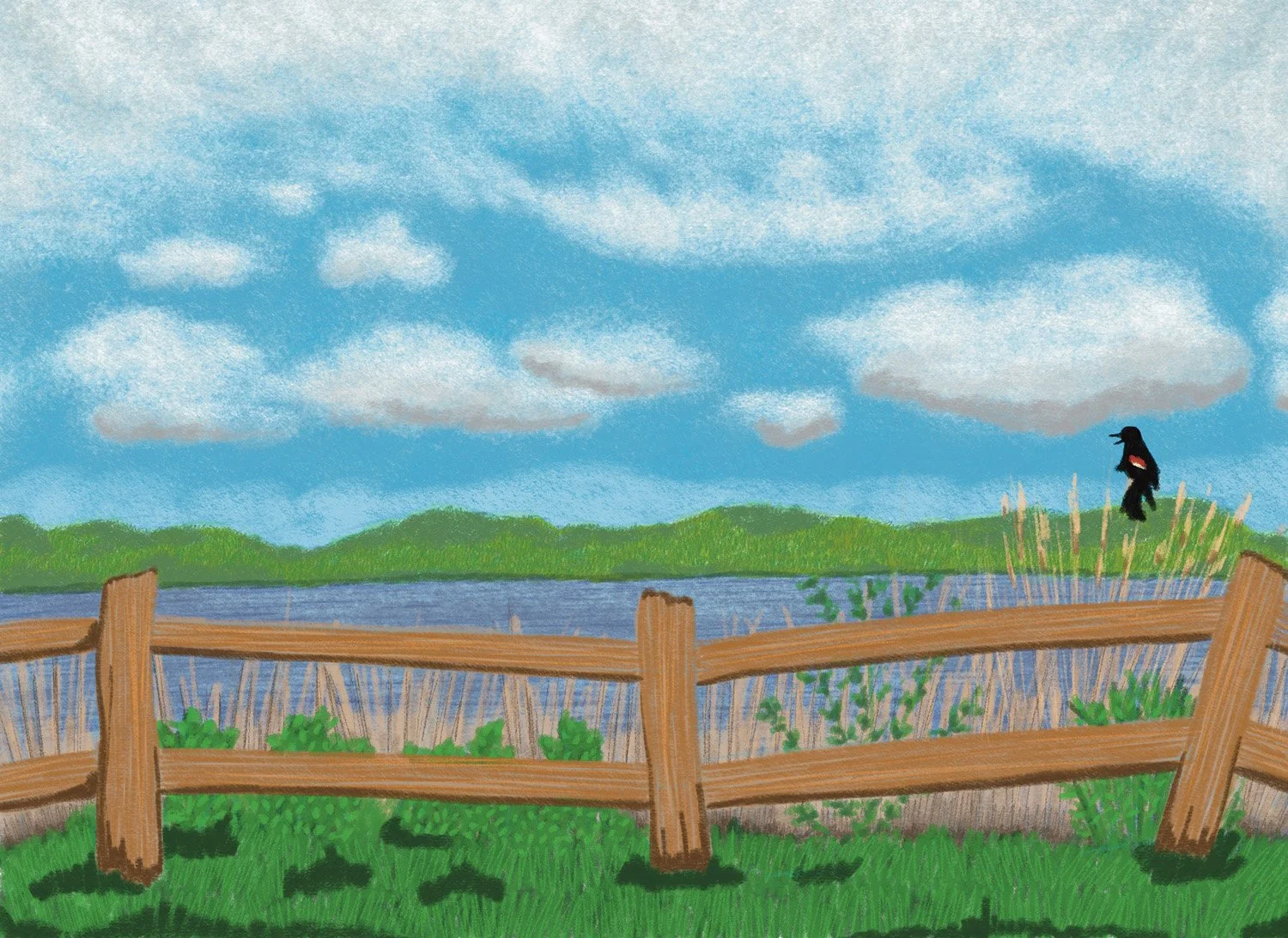
Clouds over Lake Wingra
Excessively Titled Poetry
“I am reminded of my many hours spent memorizing index cards for art history, of which I retain nothing.”
Altostratus is a blanket, cumulus is cutest,
cumulonimbus wants to storm on you, fluctus waves goodbye.
Cirrocumulus looks like mackerel, nimbostratus grays the sky,
high falutin’ is a cirrus, asperitas is kinda new to this.
Cirrostratus loves a halo, lenticularis might be aliens,
stratocumulus takes the ocean, but the gliders surf volutus.
Lacunosus, undulatus, arcus!
(A spell against a blank sky’s too-bright loom.)
Wait, let’s not forget the pileus or
p p p p
a a a a
n n n n
n n n n
u u u u
s s s s
I’m frankly overwhelmed by this,
but surely I’ll remember it’s
virga that looks like jellyfish
and mamma looks like… (cough).
To Spot or to Gaze?
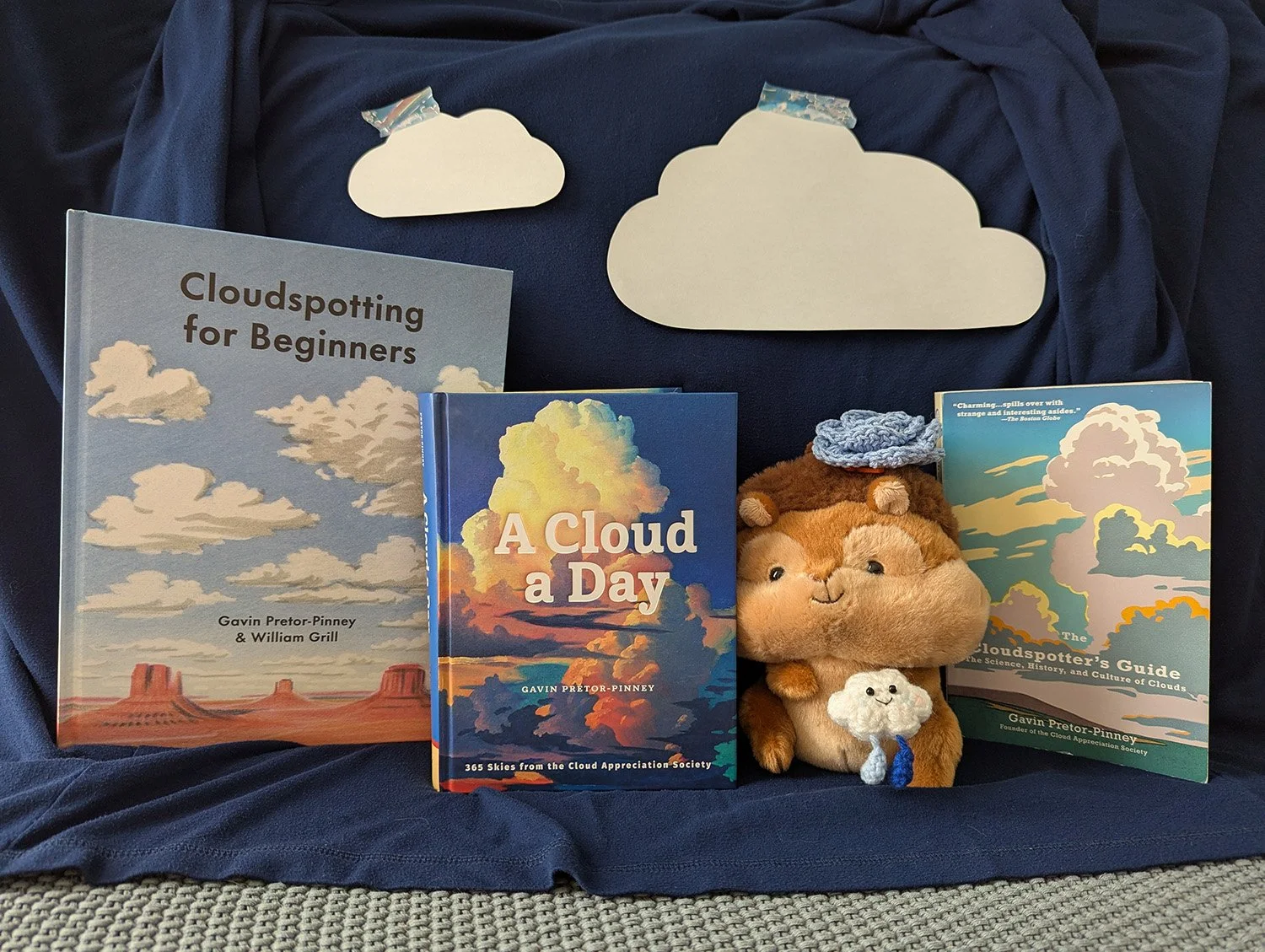
Spoiler: I’m more of a cloud gazer, but I don’t regret my education via The Cloudspotter’s Guide: The Science, History, and Culture of Clouds by Gavin Pretor-Pinney.
There are at least two options for reading a book like this—studying as if you were going to take a test (and indeed, there is a quiz in the middle for those with more gumption than myself) or letting it wash over you, allowing the most interesting bits to stick. If the latter, such books are still valuable long-term as a guide when a pertinent moment arrives.
I started out with the former approach because I was understanding things that I probably never did in my middle school Earth Science class, but after the initial rush of success, I was overwhelmed by all the species, subspecies, and similar-sounding names. Finally I asked myself, “Am I going to become someone who can ‘name that cloud’?” and confessed the answer was no, which allowed me to settle into the book more comfortably.
Clouds in Culture
There were a few attempts at humor/creativity that didn’t land (using Frankie Lymon/“Why Do Fools Fall in Love” as a construct wasn’t a great choice) and I got lost in the “don’t mistake this for this other cloud” explanations, but I generally found this book charming. My favorite parts were the historical and cultural tidbits, like:
“The artistic device called kasumi, which is Japanese for ‘mist,’ was traditionally used as a way of giving depth and perspective to landscape scenes. They generally took the form of horizontal bands, which in the early paintings of the Heian period (around AD1000) tended to be soft and transparent with a blue tinge… Besides providing the landscapes with a sense of depth, the beautiful kasumi mists sometimes had a role in punctuating a narrative within the paintings. They signified the passage of time between different scenes in an image. Never have the ‘the mists of time’ been more literally expressed in art.”
—Gavin Pretor-Pinney, The Cloudspotter’s Guide
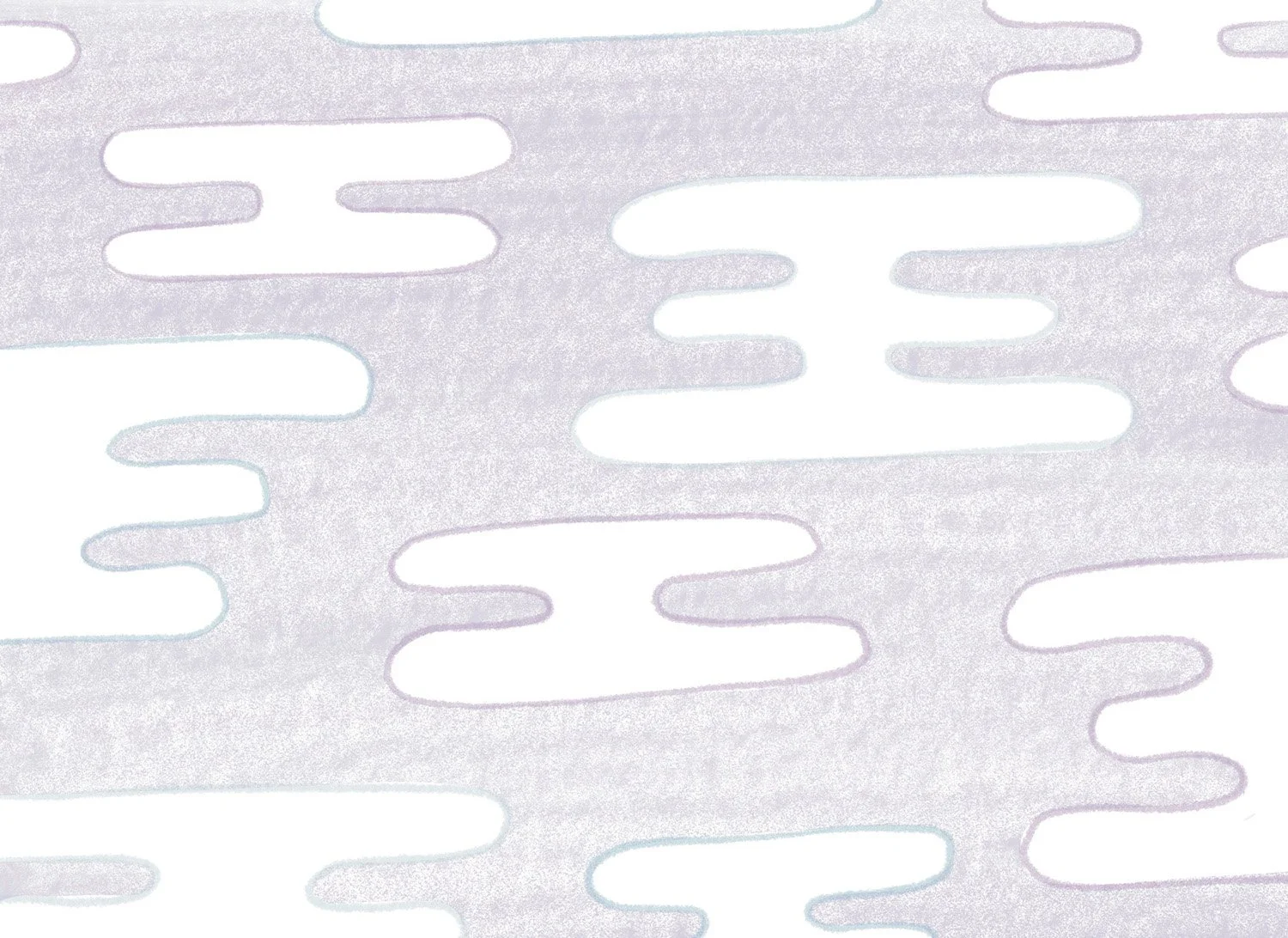
One style of kasumi, hastily drawn
The note about kasumi felt like kismet since the theme for our writing group’s summer retreat is ‘time.’ Kasumi also led me back to one of my favorite manga series, Ranma 1/2, written by Rumiko Takahashi. Akane, one of the main characters, has two older sisters, Kasumi and Nabiki. According to a Q&A archived on the Ranma fansite furinkan.com, Takahashi was inspired by clouds for each of these names. (You can see the sisters, name explanations, and photos of the cloud associations on the Ranma subreddit.)
A Favorite & Final Chapter
While the book is mostly chapters by cloud type, my favorite was the final chapter, which read like a travelogue. Pretor-Pinney writes: “…I came across the photograph of a cloud that was unlike anything I’d seen before. The aerial shot showed an extremely long, smooth tube of low cloud that looked like a white roll of meringue and stretched from horizon to horizon, with clear skies ahead of it and behind. It had formed above an exotic-looking terrain of twisting rivers and mangrove swamps. I knew it would be classified as a ‘roll cloud’ — a particular formation of the Stratocumulus genus — but it looked almost too sublime to be grouped with any of the common clouds. Indeed, the photograph’s caption explained that it had a name all to itself — the ‘Morning Glory,’ which ‘conveys the feeling of elation which its passage arouses.’”
Pretor-Pinney journeys to the other side of the world to see the Morning Glory for himself. He encounters a variety of locals, as well as out-of-towner glider pilots, as he waits day after day to see if the cloud will show. On the Cloud Appreciation Society website, you can see a photo of this truly enormous cloud in Australia and a photo of the same formation in Brazil, plus watch a video taken from a glider pilot’s view (pretty sure there’s no sound, so don’t bother fiddling with your volume like I did). Though the Morning Glory is an early riser, this colossal cloud provided a tidy close to The Cloudspotter’s Guide.
Have you seen clouds that surprised you? What did you take away from The Cloudspotter’s Guide?
Comment on this post >>
Just a Bit More…
For Serious Cloud Spotters
The Cloud Appreciation Society offers the CloudSpotter app for cloud ID. (Or NASA has the GLOBE Observer app for recording/tracking clouds, mosquito habitat, land cover, and trees if you’re interested in some citizen science!)
For Cloud Gazers Who Prefer to Keep it Casual
I highly recommend Cloudspotting for Beginners, as it provides an easy overview of cloud types accompanied by full-page illustrations by William Grill. At 96 pages, it’s also readable in one sitting.
Though I’m still working my way through it, I recommend A Cloud a Day too. Its gorgeous, full-color photographs and brief text will keep you in the clouds for a year. The book is heavier than you’d think given its appearance, which feels appropriate after we learned how much clouds weigh from Ferris Jabr in Becoming Earth (Sept. ‘25 newsletter).
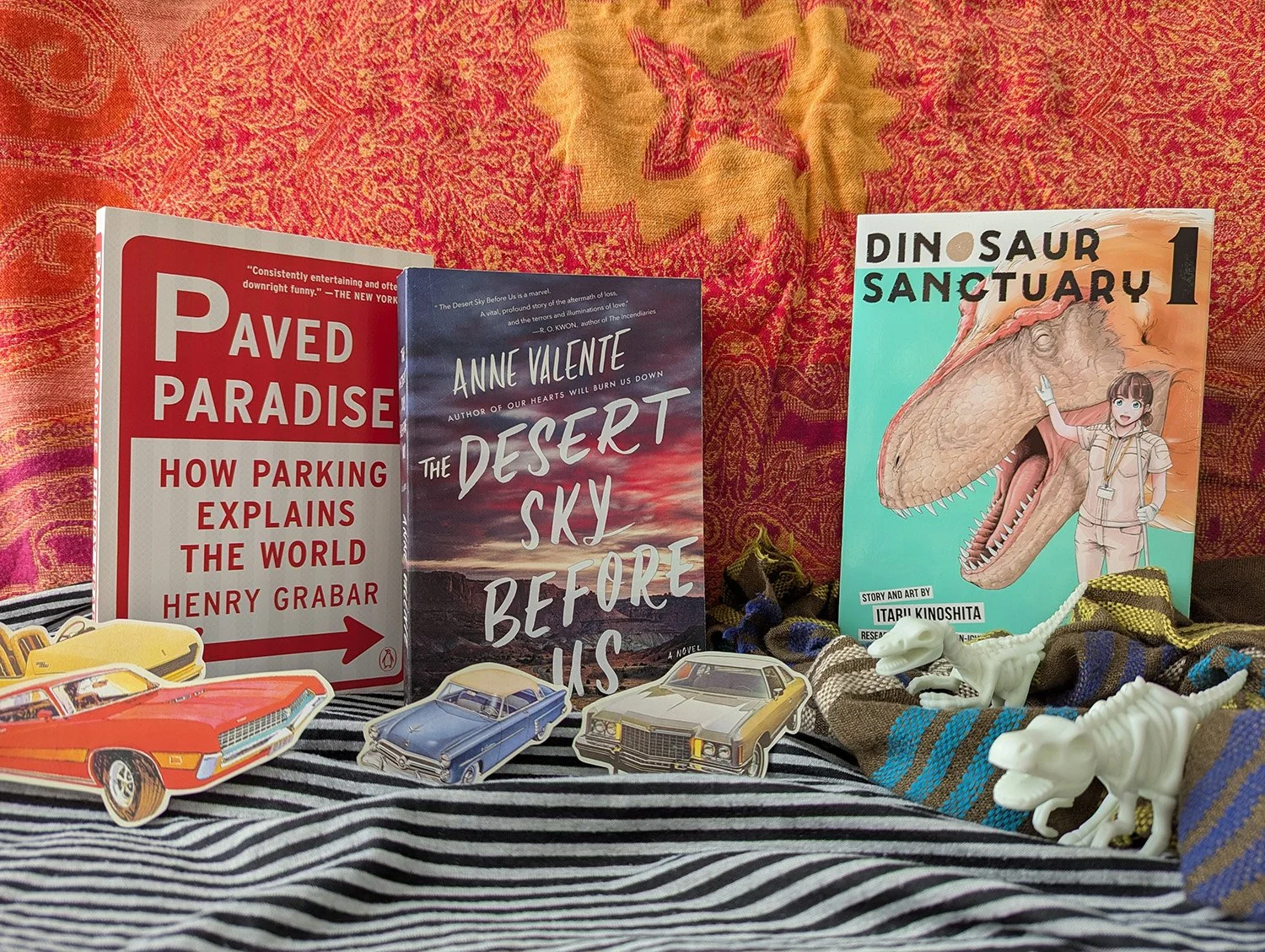
Hitting the Pavement in June
New!Fiction & Nonfiction Book Buddies
I know the nonfiction books can be a lot, especially when they’re environment-related and there’s always at least one obligatory climate change chapter. (I thought this month’s cloud ID read from 2006 probably wouldn’t, but I was wrong.) That can be rough even when we’re focused on positive action. So let’s balance it out with some fiction that ties into our nonfic picks—maybe you’ll find a book among the bunch that speaks to you.
In June, Paved Paradise: How Parking Explains the World by Henry Grabar is in the driver’s seat, alongside a road trip book about a former woman race car driver and her previously incarcerated sister—The Desert Sky Before Us by Anne Valente. Because we’ve got a spacious backseat in this vehicle, I’m also buckling in the graphic novel Dinosaur Sanctuary Vol. 1 by Itaru Kinoshita. (Dinosaurs never went extinct and they need zookeepers! How the heck does that connect? Well the sisters in The Desert Sky Before Us are headed to a dinosaur quarry and their mother was a paleontologist.)
For the July through September pairings, please visit the Book Club page.

On our anniversary trip to Milwaukee, we visited a new (to us) bookstore and picked up a few zines to read at the At Random cocktail bar. I had a dairy-free Pink Squirrel—delightful. My poor posture was sneakily photographed—less delightful.
Five Hopeful Things
What’s making you hopeful right now? Keeping my spirits up this month:
1. Many, Many Adults Reading
My friend invited me to join her team for Escape the Readathon this last month. It’s been a blast to see hundreds of adults team up online to read their way out of the clutches of space aliens. This reassures me that book-reading is alive and well. Plus, when our team lost yesterday, I was so impressed with how everyone handled it with grace and humor.
2. Northern Flicker
Lucas spotted this bird as it hunted ants on our backyard path—a type of woodpecker that we hadn’t seen in our yard before! Apparently, unlike most other woodpeckers, you usually find it on the ground due to its eating habits. See a pic and learn more on the Cornell Lab All About Birds website.
3. Resident Toads
Similarly, I don’t think I’ve ever seen a toad in our yard before, and we saw either one toad hanging out in the front and back yards, or two toads have taken up residence in their respective spaces. Now I need to go look up toad ranges…
4. The Latest Edition of Fix the News
So much good news and progress in here, especially regarding our environment and health! Their newsletter is such a bright spot in my inbox. Check out Fix the News on substack >>
5. Snail Mail
After reading Syme’s Letter Writer, I started sending more letters and postcards to friends and family with zero expectation of getting a reply. We’re all so busy, and I hope that what’s fun for me to send is also fun to receive, but I don’t expect anyone to have the desire or time to write back. What a wonderful surprise when the other day I found not one, but two, very thoughtful replies in my mailbox that dwarfed my initial missives! One of the best things about this hobby is that there is no pressure to respond quickly, which provides the additional pleasure of daydreaming about fun things to share before I write back.
See you next month! In the meantime, let’s try to


Credits
All doodles and photos by Leigh Anne Gray or Lucas Gray.
Quotations for the book review are from the 2007 paperback edition of The Cloudspotter’s Guide: The Science, History, and Culture of Clouds by Gavin Pretor-Pinney, a Perigree Book published by the Penguin Group. The quotes can be found on pages 201 and 283.